Showing posts with label favorite. Show all posts

Sunday, January 26, 2014

Satantango - László Krasznahorkai


My rating: 5/5


Book review:

I am reading Satantango at my parents' house. A communist block of flats, tiny cubicles with thin walls, through which the noise of a Tv set penetrates from my neighbor upstairs. Later on, my mother comes in my room and falls asleep on my bed. Poor mom, she is always so tired... Soon, the muffled noise of the Tv intermingles with my mother's snores. I am expelled from the depths of evil; I leave behind the colony, the putrid rooms, the decay. I come back to my banal reality. I glimpse at the half-eaten cake, the orderly room, my warm feet. I hold the book open with my toes, fingers plucked deep in my ears. Slowly, word upon word, I can hear once again the rumbling of thunder, the incessant tapping of rain. Shadowy hands pull me once more inside the sickening gloom and despair. I am back in the colony, caught up in a maddening Satan's tango.
Share:

Friday, September 20, 2013

The Notebook, The Proof, The Third Lie - Ágota Kristof

My rating: 5/5


Book review:

When I was younger, I used to have a recurring dream about a world I haven't experienced in real life: I found myself in a place that was being bombed. I was hiding inside a house, a deafening noise around me; through the windows I could see the planes and hear the explosions. I was living intensely in a dimension that was at war; I felt the terror, the helplessness. I have no idea why I had those dreams. I haven't lived through a war, I don't know how bombardments feel like. But my dreams felt real nonetheless. It could have been my reality in another life, if I were to believe in it. Or it could be the reality of my dreams, a realm where my mind continues to live without my body.
Share:

Friday, September 13, 2013

Independent People - Halldór Laxness

My rating: 5/5


Book review:

What does it mean being independent? Stop for a moment and think: do you consider yourself an independent person? I've never asked myself this question seriously before reading this novel, although I've always tried to preserve my freedom by sticking to a few personal guidelines: I avoid becoming a working slave; I can't keep my mouth shut when I observe injustice or stupidity; I can't keep my head down to gain favors; I can't stand being tied to a person just out of politeness.
Share:

Thursday, July 18, 2013

The Fish Can Sing - Halldór Laxness


My rating: 5/5

Book review:

The fish can sing just like a bird,
And grazes on the moorland scree,
While cattle in a lowing herd
Roam the rolling sea.

Starting from this Icelandic paradox put in verse, Halldór Laxness weaves an enchanting tale on the outskirts of Reykjavík, in a time when the price of a Bible was equal to that of a heifer and people still tried to cure headaches by smearing their faces with warm cow-dung. Some say that The Fish Can Sing is a coming-of-age novel, but I don't really see it that way; it is more the diary of a place, Brekkukot, and the portrait of a generation long gone, in a time when Reykjavík was just a bunch of houses inhabited by farmers and fishermen.
Share:

Friday, July 12, 2013

The Ice Palace - Tarjei Vesaas


My rating: 5/5


Book review:

A novel with a scarcity of words but with a delicate, dreamlike poetry; a story that makes you taste the coldness and isolation of winter in the middle of the summer; an adult writer who can see through the soul of an eleven year girl, down to her utmost fears; a remembrance of childhood with all its awkward moments; two girls that are linked in life and beyond; a secret that is never spoken, buried forever in ice; a promise that is kept, no matter if it brings estrangement; a wonder of nature, the ice palace, with its cold and deadly beauty.
Share:

Sunday, June 23, 2013

Târfe asasine / Putas asesinas - Roberto Bolaño


My rating: 4 out of 5


Book review:

Putas asesinas or Murderous Bitches is my first encounter with the prose of Roberto Bolaño. What can I say? I'm hooked by his talent as a story teller, by his imagination, weaving real life facts with fabricated ones. What I liked the most was the dreamy feeling I got while reading his stories, like I was sitting together with Bolaño at a bonfire and he was murmuring some tales about his life. And they felt so real that I could have believed everything he would tell me.
Share:

Friday, June 21, 2013

Pedro Páramo - Juan Rulfo

My rating: 5 out of 5


Book review:

At the end of a lot of struggling days and a 70-pages document with new words, I've managed to finish my first novel read in Spanish. As I feel like I've earned a prize, I have to thank Linda and Dolors for their support!

I'm not sure I've chosen the right novel to begin with. Apart from my poor understanding of language, the plot was bringing more confusion than I could deal with. I felt utterly frustrated at times because I wanted to read quicker and understand what was going on. But then, the slow pace made me taste mouthfuls of the wonderful sound of Spanish. Man oh man, this language is musicality itself! In the right hands, it breaths poetry through every word. And Juan Rulfo has the magic hands, this can't be denied.
Share:

Tuesday, June 18, 2013

The Door - Magda Szabó


My rating: 5/5


Book review:

Romanians and Hungarians have a long history of not liking each other. I'm no xenophobe and I have a few friends in Budapest, yet I was sometimes wondering: what does Hungary have to offer in terms of art, music and literature? They could say the same about Romanians, too; what the heck, we are questioning our place in art history ourselves! Well, after reading this novel, I've come to think that Hungarians do have their hidden gems, just the same as we do. Magda Szabó's novel was my first foray into Hungarian literature and my first step towards abating my ignorance. 
Share:

Sunday, April 21, 2013

The Lost Honor of Katharina Blum - Heinrich Böll

       
Rating: 4 out of 5


Book review:

The voice of this novel was something new to me: it is written in the form of a report, apparently reserved and unbiased, which presents the slow but effective process of Katharina Blum's public humiliation by police and press.
Share:

Thursday, April 11, 2013

The Obscene Bird of Night - José Donoso


My rating: 4/5


Book review:

The Obscene Bird of Night is one strange, twisted, haunting, obscene book. It may well be the most difficult novel I've read so far. There were moments when I felt that I could connect to it and even understand it, but most of the time I felt like floating inside a grotesque nightmare, with walled-up windows and doors, not being able to find my way out. If, by chance, I was brusquely expelled into reality, I was compelled by an utter fascination to go back in and have my brains turned to mush.
Share:

Monday, April 8, 2013

Doctor Glas - Hjalmar Söderberg

     
Rating: 4 out of 5


Book review:

This short novel is a melancholic guide of Stockholm. It is a compendium of thoughts and reflections upon life from a peculiar character. It is a story of alienation and unrequited love. And it is also the story of a planned murder.

Although more than a hundred years old, this novel feels as fresh as if written yesterday. The only hint of its age are depictions of places in Stockholm that no longer exist and some obsolete debates (on abortion, for example), but otherwise the language doesn't fell dated and the ideas are as universal as ever.
Share:

Wednesday, March 27, 2013

The Guillotine Squad - Guillermo Arriaga


My rating: 4 out of 5


Book review:

I haven't seen any of the Arriaga/Iñárritu movies because they seemed too tough to watch, but this doesn't mean I wasn't curious about this Mexican (script)writer. Especially when I found the first book he had published in a second-hand bookstore, for 1.50 $. Yup, sometimes my reading flow goes with the bargains that I find on the way.

I was neither prepared to like it, nor dislike it, a state of mind that I wish I had with every book that I read. What I enjoyed most of all in The Guillotine Squad was the dark humor, a feature that I've always welcomed in books and movies.
Share:

Monday, February 18, 2013

The Arrival - Shaun Tan


Rating: 5 out of 5


Book review:

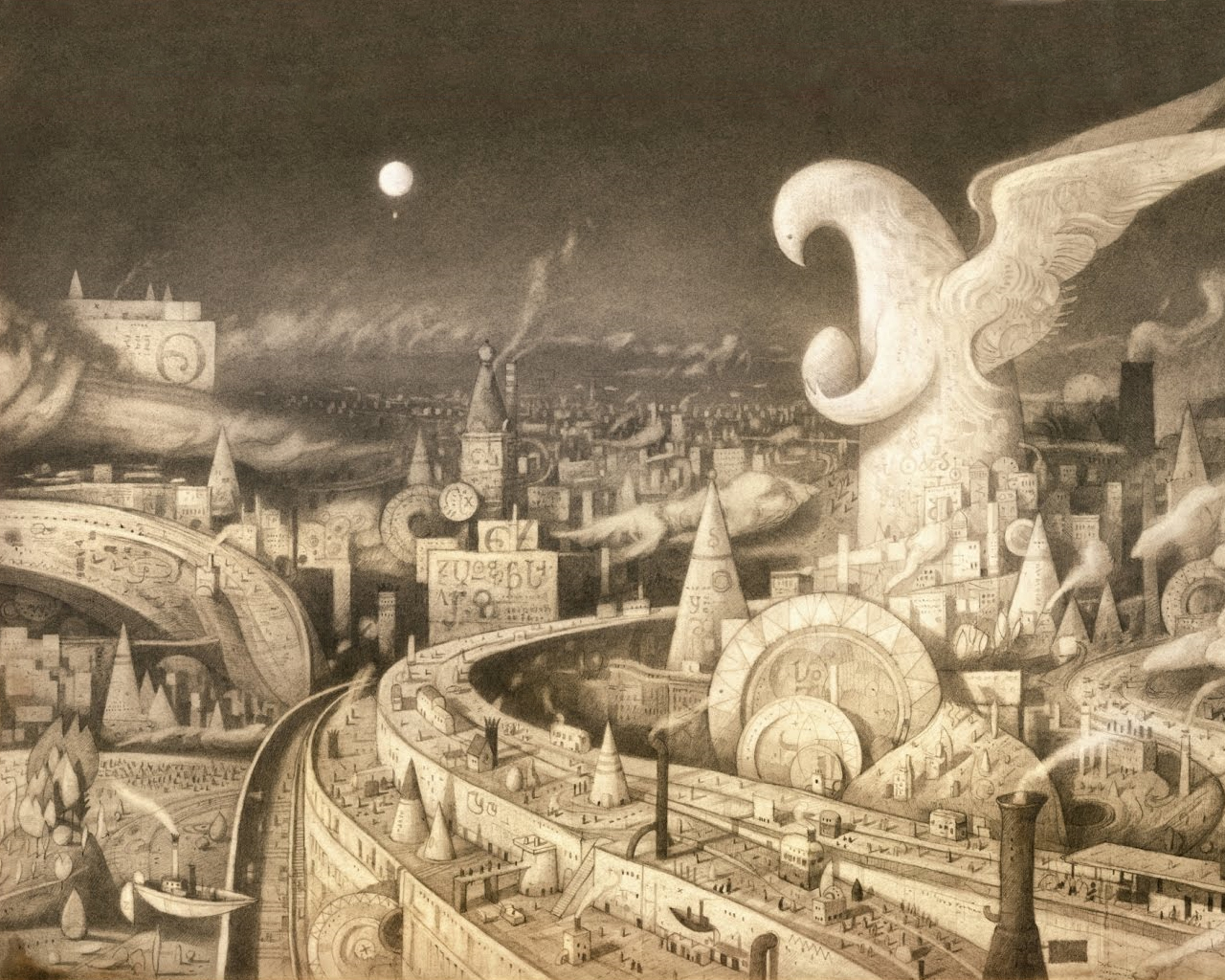
This is an amazing book, although it has no words. The narrative is slowly building from the wonderful drawings of Shaun Tan and from the imagination and sensibility of each reader. I could not believe that I was experiencing such a complex display of feelings just by looking at some images: I was elated, then I was sad, then I was happy, then I was elated some more.


As I hadn't previously read anything about The Arrival, I thought that this was some sort of science-fiction graphic novel (silly me!). And maybe it was better that way, because I had to put my mind to work to understand what was going on.


The protagonist leaves his wife and daughter behind and travels to a distant land. He might as well be going to a different planet, because everything there is so strange and far from the normality he's used to. You must see with your own eyes the world imagined by Shaun Tan, you must! I was like in a trance, scanning the whole picture for the tiniest details.

description
The white dot that looks like a moon is in fact the hot air balloon 
which brings the protagonist into the foreign land.

The people there appear to each have a pet, which are peculiar animals, and soon the emigrant will find a pet of his own (it felt so heartwarming, like connecting to the character on paper - strange!). This presence of animals throughout the drawings reminded me of Philip Pullman's dæmons, a very interesting concept from The Golden Compass series.


We follow the protagonist as he struggles to find a lodging and a job, his encounter with different people (some are emigrants like himself), his acquaintance with the foreign language, the strange landscape, the peculiar fruits and animals. It is an old story dressed in new, wonderful clothes.

I would recommend this to everybody, young and old, even if they are not fans of the graphic novel genre.
description

This piece of music (Erik Satie - Gnossienne 4) should definitely be the soundtrack of The Arrival:


Share:

Saturday, January 12, 2013

Ice - Anna Kavan


Rating: 4 out of 5


Book review:


Edit (104 days later): Despite my initial 3 star rating, I feel compelled to give this book another star. I must admit that Ice is still haunting me, as some of the powerful images it aroused are still vivid in my mind. Few books have this power over me.

-----------------------

While I found Ice to be an interesting read, with moments of pure beauty and originality, in the end I was glad it was over, because it had failed to keep me under its spell for its entirety. While being a short book, to me it seemed awfully long, possibly because it is repetitive on the verge of becoming annoying. The magic that worked its charm in the beginning started to lose its power when the same things happened again and again, when I got tired of the uncertainty and wanted to tell the difference between what was real and what was not. And I do love tangled, fantastic tales (Mulholland Drive is one of my all-time favorite movies).

At first, I was mesmerized by the strange story of a man set out in search of a fragile girl with white hair, in a menacing landscape that is gradually overtaken by ice. His quest becomes an obsession and he  follows her to some disaster-stricken places, but she always seems to sleep through his fingers. His search is impeded by a third character, the Ward, who seems to have taken possession of the girl, but also by the fact that the girl herself does not want to be found and rescued by the man.

Ice has no actual plot and no reliable storyteller. It's like falling through a series of weird dreams, not being able to tell the difference between reality and unconsciousness. The nameless narrator has some recurrent daydreams about the girl he is chasing, some of  which left a powerful impression upon me, and for that alone it was worth reading this story.


Share:

Wednesday, January 9, 2013

The Heart is a Lonely Hunter - Carson McCullers


My rating: 5 out of 5


Book review:

The Heart Is a Lonely Hunter is only partly a coming-of-age novel. There are several threads of the story, following the five main characters of the book, all interesting people, with a deep inner world. One would think they could cure their loneliness once they get to know each other, but things are more complex than that and don't always turn out the way they should. And do they actually come to know each other in the end?

John Singer is a deaf-mute who is living with his only friend, a fat Greek, Spiros Antanopoulos, who has the same handicap. After the latter is sent to a mental hospital, Singer moves to a boarding house and gets to know a handful of people, who from then on start to gravitate around him, eager to speak about their thoughts and torments, having the impression that the mute has a superior understanding of life. While with Spiros, he was the one who used to talk with his hands every evening, but now he has become the one who listens. 

Mick Kelly is a 14-year old girl with a complex inner world; she dreams of becoming a musician and of travelling to distant countries covered in snow. She is slowly discovering her womanliness and sexuality. I loved the metaphor of her soul divided in an outer and inner chamber, I loved the way she perceived music.
Her connection to music was disturbing for me, as I too used to hear music in my head and dreamed of playing it on the piano. Not unlike Mick, I studied the piano for eight years, yet I got lazy in the end. Reading about what she felt about music brought about memories of my own ambitions and felt sadder to have failed. 

Dr. Copeland is an intelligent black man whose purpose in life is to educate his people, to transform their beliefs and help them transcend their condition, in order to make a better life for the black race. He became estranged from his wife and children and he had failed to pass his revolutionary ideas onto them. Through his story, we get to know the harsh lives of black people and their resistance to change. 

Jack Blount is a half-mad guy, a wandered who made a sudden appearance in town, claiming he could understand, that he knew a truth that others were too blind to see. He finds comfort in the mute John Singer, whose silence gives him the aura of understanding and knowing. 

Bill Brannon is the owner of a cafe where all the characters gather to eat and drink. He doesn't say much, but we get to know his thoughts. He is attracted by strange people, by outcasts, and so he takes pity on Jack Blount. 

I was wrong about this book on so many levels! First, I thought it was written by a guy, when instead Carson was a woman, who was merely 23 when she wrote this book. Wow! Such complexity of language and ideas is usually bestowed upon writers much later, after life has granted experience and depth. I can't imagine how someone can write like this at 23!
  
Secondly, I thought I was getting a cheerful, carefree coming-of-age novel, when instead I was immersed in a complex, serious and heart-wrenching story. There's so much loneliness in here and the events seem to head for disaster. I would imagine all sorts of terrible things that could happen to the characters. The pressure was constantly building, it seemed a question of paragraphs until the disaster would struck, yet it only came towards the ending.

Thirdly, I expected some romance going on, but I didn't get any - in the standard form, that is. There was love, but it was awkward, unfulfilled, sometimes twisted. The strangest of them all was the powerful attachment that Singer felt for his friend Spiros, despite the Greek's passive, greedy and mean character. In the end, nobody was capable to understand what lay beneath Singer's calm, friendly appearance and what went on in his soul. They were just as lonely and estranged as in the beginning of the story...  


Share:

Friday, December 14, 2012

Un cerc în iarbă - Oek de Jong


My rating: 4 out of 5


Book review:

Although it took me some days to finish this book, I enjoyed every bit of it (except, maybe, the political stuff). It is such a dense prose that I couldn't read more than a chapter at a time, as it claimed quite an effort from my brain cells. I had to dwell on a lot of paragraphs in order to understand the meaning, and I must confess that, sometimes, I didn't quite get it. Yet, there was such beauty and philosophy in Circle in the grass that I feel I must read this book again, in the same manner - small doses, time to ponder, because too much of it will make my head explode.

Circle in the grass is a story about passionate love, art and politics, with deep introspects about human condition, poetry, love, relationships. There are some strong characters here, whose inner and outer lives are followed in turns, and there are also amazing fable-like stories from parts of Italy. 
And yes, above all there is Rome, with its winding streets and compelling architecture, which will stir a deep melancholy for those who have visited this wonderful city at some point in their lives.

In 1978, Hanna Piccard, a Dutch journalist, comes with her two cats to work in Rome and there she meets Joe Kurhajec, a Vietnam-veteran turned sculptor. Through him she comes to know Andrea Simonetti, a divorced poet who lives with his 13-year-old daughter, Leda. 
Soon, a tormenting love sparks between Hanna and Andrea, despite the fact that they are so different. The novel follows their love from the awkward beginning, through the difficult time they have to adapt to each other, till the final stage (which I won't spoil). While Hanna is more action-oriented, jealous, suspicious and deeply engaged in their affair, Andrea is contemplative, distant and sometimes cruel, fearing the loss of individuality (or at least this is how I got it).

Meanwhile, Andrea is working on his very long poem, in which one of the characters is inspired by his employer and friend Zucarelli, the head of the museum where Andrea works as an art historian. And how I loved when, towards the end, Zucarelli denies the role that it was attributed to him in the poem and chooses the fate of the hero instead...

Hanna, Andrea, Leda and Zucarelli take turns in expressing their inner world in this novel, through voices and personalities which are quite distinct. Leda is creative, intelligent and almost as contemplative as her father. She gradually leaves her childhood behind and has her first crush, on a stranger. 

The political background is also of importance - Italy is under threat of terrorism from the Red Brigades and the events culminate with the abduction of Aldo Moro, ex-prime-minister. There are some well-spoken words about the trajectory of the consumerist world and about why people are revolting - politics has never been my cup of tea, yet it was interesting to read Oek de Jong's ideas on the subject.

For more experienced readers, Circle in the grass may even earn 5 stars. Such a pity this book is so little known...

EDIT: Apparently, this book is not translated into English and it is such a loss! This book deserves a wider audience, it is a truly great novel. 


Share:

Monday, November 19, 2012

The Noodle Maker - Ma Jian


My rating: 4 out of 5


Book review:

The Noodle Maker was a pleasant surprise for me. It consists of several loosely interconnected short stories,  sometimes with a touch of surreal, often with a delicious dark humor, and mostly absurd.

A satire of the Chinese society affected by the Open Door Policy (instituted by Deng Xiaoping in 1978), this book has an interesting array of characters: the failed writer who dreams of his big novel, but instead writes political-oriented articles about everyday made-up heroes; the professional blood donor who has become a rich man exploiting the benefits of his occupation; the jealous actress who wants to get revenge on her lover by committing a most peculiar suicide; the young woman whom nobody thinks is still a virgin because of her rather huge breasts; a talking dog who debates with a man that dogs are superior to humans.

My favorite was the story of a middle-aged man who still lived with his mother, both taking care of their business - an independent crematorium. Man, was this a bizarre and twisted story! The son has a whole philosophy in choosing the right music for the dead, according to their status in life and the money their relatives pay.

There was also a mention of Nicolae Ceaușescu, out late Romanian dictator, in a funny context (I'll try to translate it):

The year when Ceausescu was due to visit their town, the mayoralty decided to hide the ugliest buildings on the main boulevards behind pressed wood panels, previously painted as to resemble a line of good-looking houses. Ceausescu was passing in a hurry anyway, so only his first impression was of importance.

What Wikipedia says about the author:

Ma Jian is a vocal critic of China's Communist regime. His works explore themes and subjects that are taboo in China. He has continually called for greater freedom of expression and the release of jailed writers and other political prisoners. As a result, his books have been banned in China for the last 25 years, and since the summer of 2011, he has been denied entry into the mainland.

I strongly recommend this book if you want to get a cynical glimpse of China, if you enjoy dark humor and don't mind a heavy dose of absurd and surreal.


Share:

Monday, November 5, 2012

The Palace of Dreams - Ismail Kadaré


My rating: 5 out of 5

Book review: 

I wonder why so few people have read this novel, because it's quite amazing. I can't say that it's completely original, because it reminded me of Kafka (The Castle) and Saramago (All the Names), but imagining an institution where people's dreams are analyzed... That is a brilliant idea, masterfully developed by Ismail Kadaré.

Mark-Alem comes from a powerful Albanian family, the Quiprili (Köprülü), and his relatives decide that he should apply for a job at one of the most influential institutions of the Ottoman Empire - Tabir Saray, the Palace of Dreams. Thus he begins his ascent to the top, although fearful and confused, never fully aware of what he is supposed to do. In this huge machinery of control, the dreams from all over the empire are gathered, sorted and analysed, in order to choose one Master Dream that is presented each Friday to the Sultan. Dreams are believed to foretell important political events, thus being of utmost importance to the Empire.

We follow Mark-Alem's journey through the mysterious Palace of Dreams, with its nightmarish passages where he usually gets lost, with the thousands of dreams stacked away in its huge underground archive, with the kafkian beaurocracy and the strange happenings that make people paranoid. Without realising, Mark-Alem becomes an active part in the events that will unfold in the story, bringing misfortune to his family.

Absorbed in the world of dreams, Mark-Alem comes to believe that this is the real world, powerful and vivid, while the reality outside gradually becomes gray, dull and less and less attractive. He gets more and more isolated, his relatives remaining his only connection to the earthly world. He seems oblivious to any romantic relationship and the only mention of a possible wife comes from his uncles, but we don't ever get to know the girl. The lack of a sexual dimension makes the character a bit too flat, but contributes to his total immersion in the fantastic world of dreams, a sort of hell that Ismail Kadaré wanted to create in his novel.


Share:

Wednesday, October 24, 2012

As God Commands - Niccolò Ammaniti


My rating: 5 out of 5


Book review:

This was quite a powerful story, like a tornado sweeping off the outside world and leaving nothing but me and this book. At first, the violence made it a little hard to read (I was not sure if I would finish it), but eventually I was so immersed in the story that I came back to reality just to pray that the ending won't be a bad one. And it wasn't.

From the opening chapter, I knew this book will be different from the ones I've read so far. It is a harsh real-life story of people living at the edge of society, people who struggle for a job and a better life - not always through honest means. Although they are not entirely faithful, they turn to God in the key moments of their existence, either to pray or to ask for an answer. 

Come Dio comanda is the story of a 13-year old boy, Cristiano Zena, who lives with his father, Rino, an unemployed drunkard and Nazi sympathizer who has violent episodes, but who loves his son more than his life. Rino's two friends, a mentally handicapped guy and another drunkard whose wife has left him, are the only thing close to a family for Cristiano. Despite the rough world in which he lives, Cristiano is not a tough boy. He has problems adapting, he doesn't have other friends apart from his father's, and he is shy with girls.

Everything will change beginning one stormy night, when the three grownups decide to steal money from an ATM. The original plan will never take place, as each of them takes a different path that night, that will change their lives forever. Cristiano is swept into the unfolding events, an experience that will affect and transform him deeply. 

The novel is cinematic, the characters are skilfully built, I was right there amidst the story. No wonder it was made into a film - it has the perfect plot for an European movie. What an incredible book! I'm still under its influence.  


Share:

Sunday, August 5, 2012

Under the Glacier - Halldór Laxness


My rating: 5 out of 5


Book review:

Here's an Icelandic writer of which I've heard nothing about, despite the fact that he won the Nobel prize for literature. I found the book by chance, the synopsis sounded interesting enough, so I began reading and... helplessly fell in love with the novel. 

This is Halldór Laxness' only book translated into Romanian, but I'm anxious to read some of his other works, especially Independent People.

Under the Glacier is truly an amazing book, which made me laugh (or at least giggle), think and wonder. It is a delightful blend of fantasy and reality which immerses the reader in a mysterious, yet earthly dimension. Even now, when I think of it, the magical world of the parish by the glacier is still vivid in my mind and prolongs its fascination upon me.

The way the dialogues are presented is a little bit strange: instead of the usual lines, there are the names of the interlocutors. It was a bit distressing at first, but this annoying fact was gradually forgotten since the dialogue became absurd anyway, yet so savory and funny that I could no longer find it the least fault.

The writing is full of humor (I found myself laughing many times) and the absurd situations that emerge are extremely delicious. The blending of reality with fantasy is in the perfect dose for me - at the end I was left in a state of reverie, wondering how much of what had happened was real. Some facts are confirmed, others are left unexplained, but this doesn't diminish the magic atmosphere of this forgotten place at the end of the world, governed by the glacier and the sea birds and populated by a bunch of more or less bizarre people.


description
Iceland through the lens of photographer Ragnar Axelsson

description
The old man may well be the priest from the parish near the glacier (photographer: Ragnar Axelsson)


Share:
Scroll To Top